ITC and OUTREACH have joined hands to lead significant initiatives aimed at preserving soil and water resources, promoting sustainable farming practices, and fostering social forestry in the Hunsur and K.R. Nagara taluks of Mysuru district. The primary objective of this project is to enhance rainwater harvesting through the expansion of water storage capacities and the construction of new water harvesting structures. The project also seeks to empower farmers with the necessary knowledge and skills to adopt climate-resilient and sustainable agricultural practices.
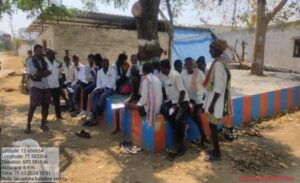
An essential component of the project is community empowerment, which includes raising awareness through village-level meetings, wall paintings, signages in public areas, providing training, organizing workshops, and facilitating exposure visits.
Enhancing Soil Moisture Conservation
Table of Contents
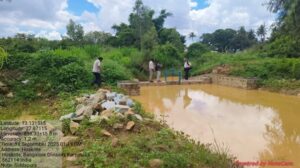
A key focus of sustainable agriculture is the reduction of soil erosion and the optimization of water use. To address these challenges, trench cum bunding work was implemented across the lands of 39 farmers, covering 71.66 hectares of agricultural land. This activity helped reduce water runoff and soil erosion. Additionally, the project involved desilting 16 existing water tanks, wherein nearly 2,31,570 cubic metres of silt was removed from the tanks, enhancing rainwater harvesting capacity of the tank and used to improve the soil quality of 706.12 hectares of farmer’s land, benefiting 515 farmers. To ensure equitable access and utilization, 16 Tank User Groups were formed, involving 132 farmers. Approximately 284.68 hectares of government- owned wastelands were repurposed by planting various indigenous tree species, such as honge, mathi, neem, and Malabar neemwood (hebbevu). This reforestation initiative
not only contributes to biodiversity but also offers long-term environmental benefits.
Holistic Integrated Agriculture Practices
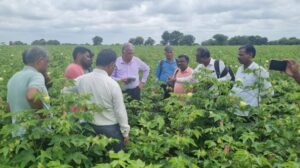
Integrated agricultural practices balance ecological sustainability and economic viability. The Farmer Field School approach implemented in the project helped farmers understand the ecological dynamics of their crops, enabling them to adopt crop production and protection technologies tailored to their specific needs.
Practical demonstrations were conducted across 173.45 hectares of farmland, involving nearly 137 paddy-growing farmers. These demonstrations covered various technologies, including the introduction of new crop varieties, integrated crop production methods, drum-seeder sowing techniques, and alternate-wetting-and-drying (AWD) methods, using water level-checking pipes.
Furthermore, water demand management practices were promoted among over 160 farmers growing water-intensive crops like arecanut, coconut, and banana. These practices included mulching, the use of ring basins, coconut bucket traps with pheromones, and venturi fertilizer injectors, contributing to more sustainable and efficient agricultural practices.
Promoting Sustainable Social Forestry
Social forestry, which involves managing and safeguarding forests alongside reforestation efforts, and agroforestry, which combines crop cultivation with forestry, were also key components of the project. This integrated approach enhances ecosystem services, such as nutrient recycling, pest control, and hydrological process management, contributing to more sustainable land use systems.
In this project, forestry trees were promoted on individual farmer’s lands and in areas where tobacco curing processes are adopted. A mix of tree species was encouraged across 1166.43 hectares of individual lands, benefiting 1186 individuals. Additionally, 294.42 hectares of land surrounding individual curing facilities of 1471 farmers were also part of the social forestry effort, furthering sustainable land management and ecosystem enhancement.